Key takeaways
- An AI influencer is a social media account built around a person who does not exist. Some say so openly; others present themselves as real women.
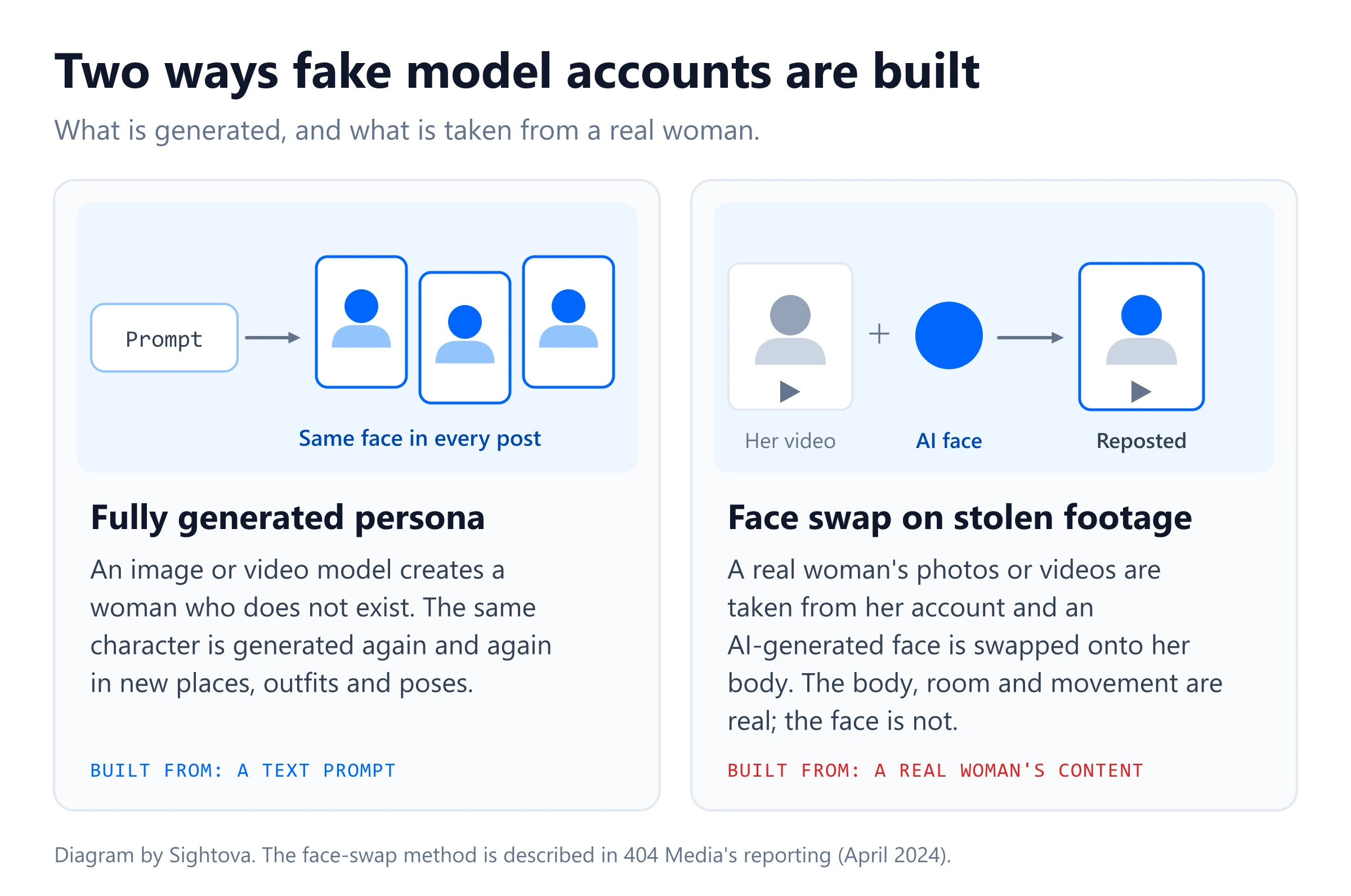
- There are two main methods: a fully generated persona, or an AI face swapped onto photos and videos taken from real women's accounts.
- Disclosed virtual influencers reach millions of people. Lu do Magalu, a Brazilian retailer's virtual presenter, had about 8 million Instagram followers in 2025.
- Undisclosed accounts move followers to paid subscription sites and are used in romance and payment scams. Face-swap accounts use real women's bodies without consent.
- Sightova detects AI-generated images with pixel-level detection, invisible watermarks and C2PA credentials, and checks AI-generated video frame by frame on the Starter plan and above.
Contents
Definition
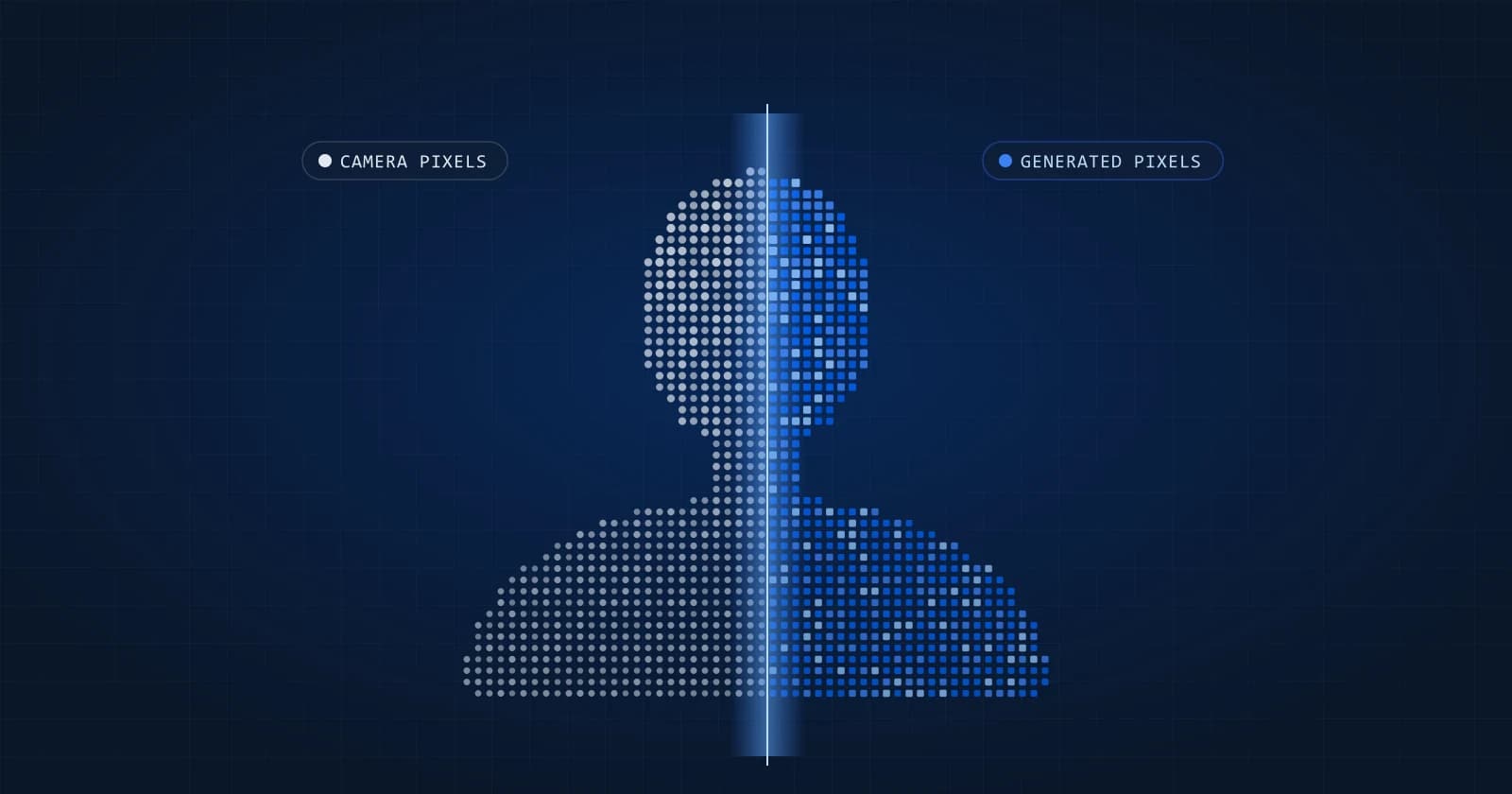
An AI influencer, also called a virtual influencer or AI model, is a social media account built around a person who does not exist. The face, the body and often the captions are generated by AI. The account posts, gains followers, takes brand deals and answers messages like any human creator.
Two kinds of account use the same technology for different ends:
- Disclosed virtual influencers. A brand or agency runs a character and says it is virtual. The audience knows, or can find out, that no real person is behind it.
- Undisclosed fake models. The account presents an AI-generated woman as real, or puts an AI face on real women's content, and uses the trust that creates to sell subscriptions or run scams.
This guide names only accounts that describe themselves as AI or that news outlets have publicly reported as AI-generated. It shows none of their images.
Disclosed AI influencers with large followings
| Persona | Background | What has been reported |
|---|---|---|
| Lu do Magalu | Virtual presenter of the Brazilian retailer Magalu | About 8 million Instagram followers and 7.4 million on TikTok in August 2025 |
| Lil Miquela | Virtual character, signed by the talent agency CAA in 2020 | Named one of TIME's 25 most influential people on the internet in 2018 |
| Aitana López | Created by the agency The Clueless | Brings in about €3,000 a month on average, and once €10,000, according to Fortune (November 2023) |
| Kenza Layli | Moroccan AI persona | Won the first "Miss AI" pageant, run by the subscription platform Fanvue, in July 2024 |
| Mia Zelu | Anonymous creators | Went viral in July 2025 with posts from Wimbledon, where she never was. The account had more than 160,000 followers, and its AI origin was disclosed behind a "Read more" button |
The Mia Zelu case shows how thin disclosure can be. The account did not hide that it was AI, but the disclosure sat behind a "Read more" button, and coverage described followers who took the posts at face value.
How fake model accounts are built
Fully generated personas
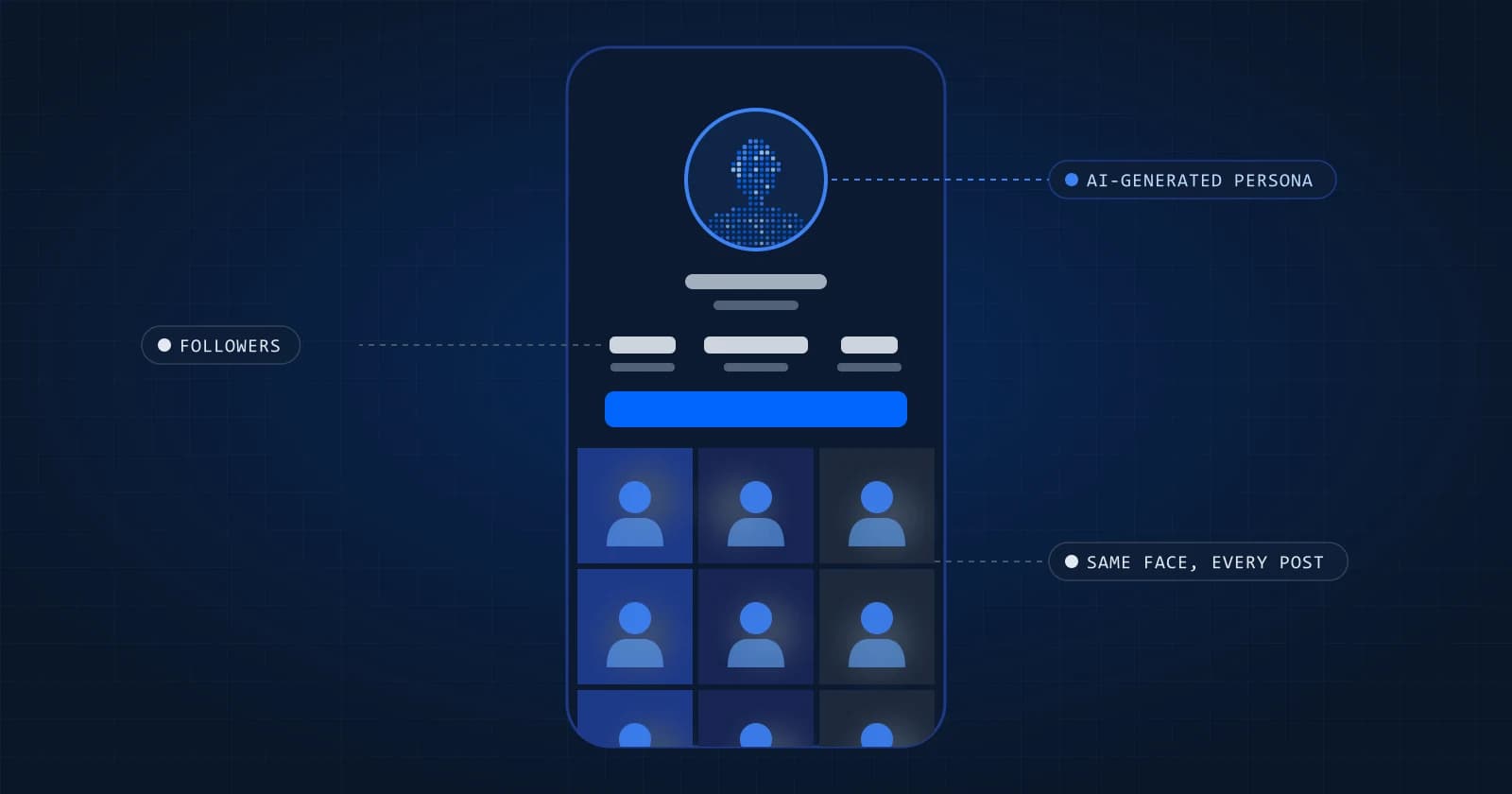
An image or video model creates a woman who does not exist. The operator keeps the same face across hundreds of posts and places her in new settings, outfits and poses. Because nothing is photographed, the persona can post every day, from anywhere, at no cost beyond the software. Our guide on how deepfakes are made explains the models behind this.
Face swaps on real women's content
The second method starts with real footage. In April 2024, 404 Media reported that AI influencer accounts were taking real videos from real women and swapping AI-generated faces onto them, then linking to paid pages on Fanvue, a subscription platform. In a later review of more than 1,000 AI-generated Instagram accounts, it found that many used photos and videos stolen from adult content creators and Instagram models.
These accounts look more convincing than fully generated ones because the body, the room, the lighting and the movement are real. Only the face is generated. The woman whose body is shown gets no credit, no payment and no say.
How the accounts make money
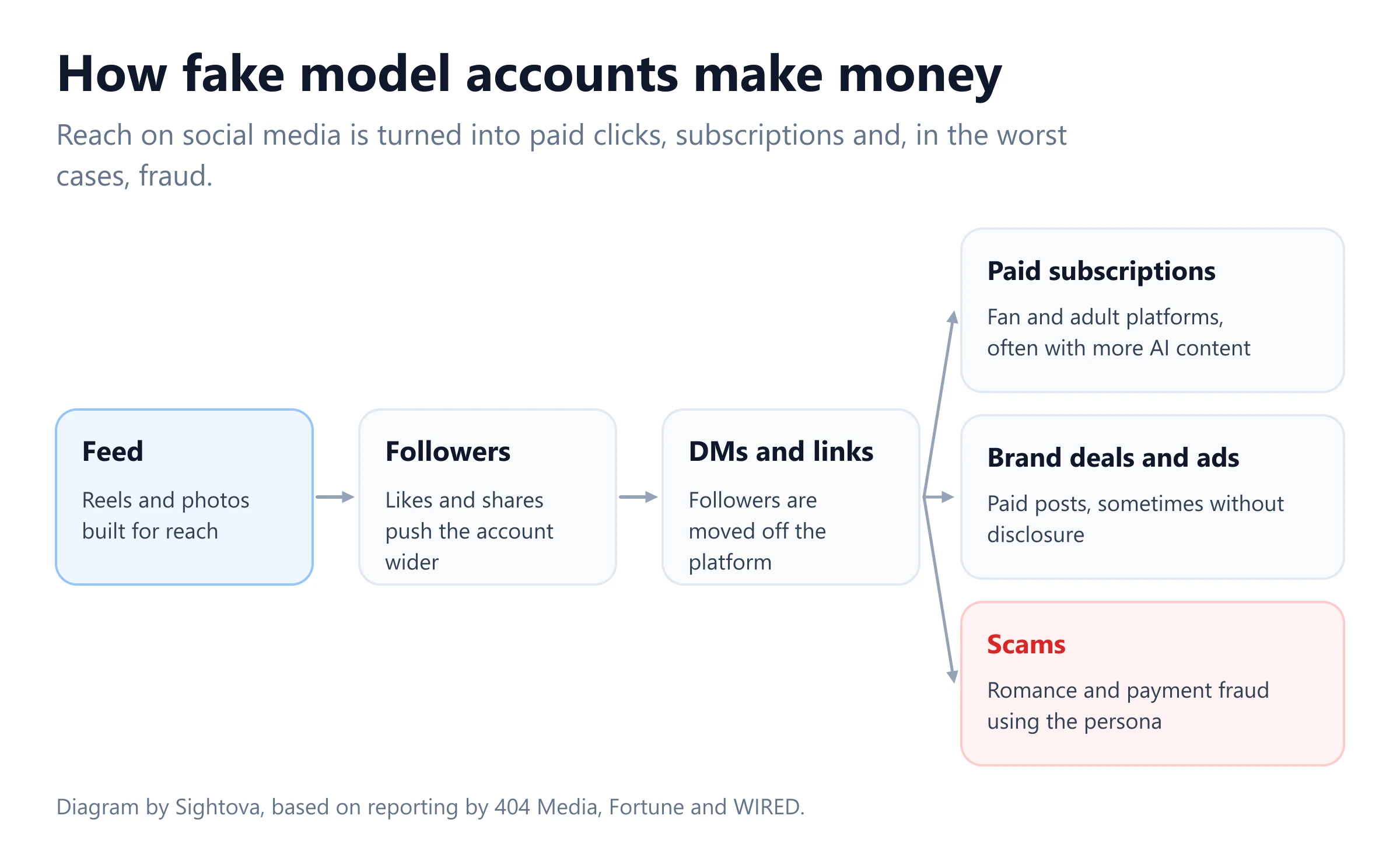
- Reach. The feed is built to be shared: attractive, polished, posted often. Followers become the asset that is sold.
- Paid subscriptions. Links in the bio lead to fan and adult platforms. AI accounts send Instagram followers to paid pages with more AI content, as Business Insider reported, and Fanvue openly hosts AI creators and ran the Miss AI pageant.
- Brand deals. Disclosed virtual influencers are paid like human ones. Fortune reported Aitana López's monthly income, mostly from advertising.
- Scams. A convincing female persona is the starting point of many romance and payment scams. WIRED reported in April 2024, as summarised by 9to5Mac, that romance scammers had moved to real-time face swapping on video calls, so a victim who asks to see the person live sees the fake face move and speak.
The harm
To followers
Followers send money, gifts and personal information to a person who does not exist. Paid subscribers believe they are paying a real woman. Romance-scam victims lose savings to someone who controls the persona. The US Federal Trade Commission's updated Endorsement Guides of June 2023 explicitly cover virtual influencers, so paid promotion by an AI persona has to be disclosed like any other.
To the women whose content is used
Face-swap accounts take a real woman's body, home and work and present them as someone else's, often from adult content creators and Instagram models. When the content is sexual, the harm is close to the non-consensual imagery described in our guide to deepfake pornography.
To platforms and brands
Fake accounts distort the engagement figures advertisers pay for, and they bring fraud onto the platform. Meta asks people to disclose realistic AI-generated video and audio, and TikTok has asked creators to label realistic AI content since 2023. In the EU, Article 50 of the AI Act requires deepfake content to be disclosed from 2 August 2026. Labels only work when the account applies them or the file still carries its metadata.
How to tell an AI influencer is fake
No single sign proves it, but several together are a strong indicator:
- Too consistent. The same flawless face, skin and hair in every post, whatever the setting, light or time of day.
- No unscripted video. Plenty of polished photos and short clips, but no live streams, no candid video and no other people who tag her.
- Face-swap tells in video. The face looks sharper or softer than the body, the edges of the jaw and hairline shimmer when the head turns, or hands passing in front of the face distort it.
- The body appears elsewhere. Searching for a distinctive video or setting turns up the same clip on another woman's account.
- Hidden or vague disclosure. "AI" or "virtual" is buried in the bio, behind "Read more", or in a hashtag.
- The money trail. Fast follower growth, a link in bio to paid content, and private messages that move quickly to other apps, gifts or money.
- Provenance. Content credentials and invisible watermarks can show that a file came from an AI tool. Screenshots and re-uploads usually strip the credentials, so check the original file where possible.
How Sightova detects AI influencer images
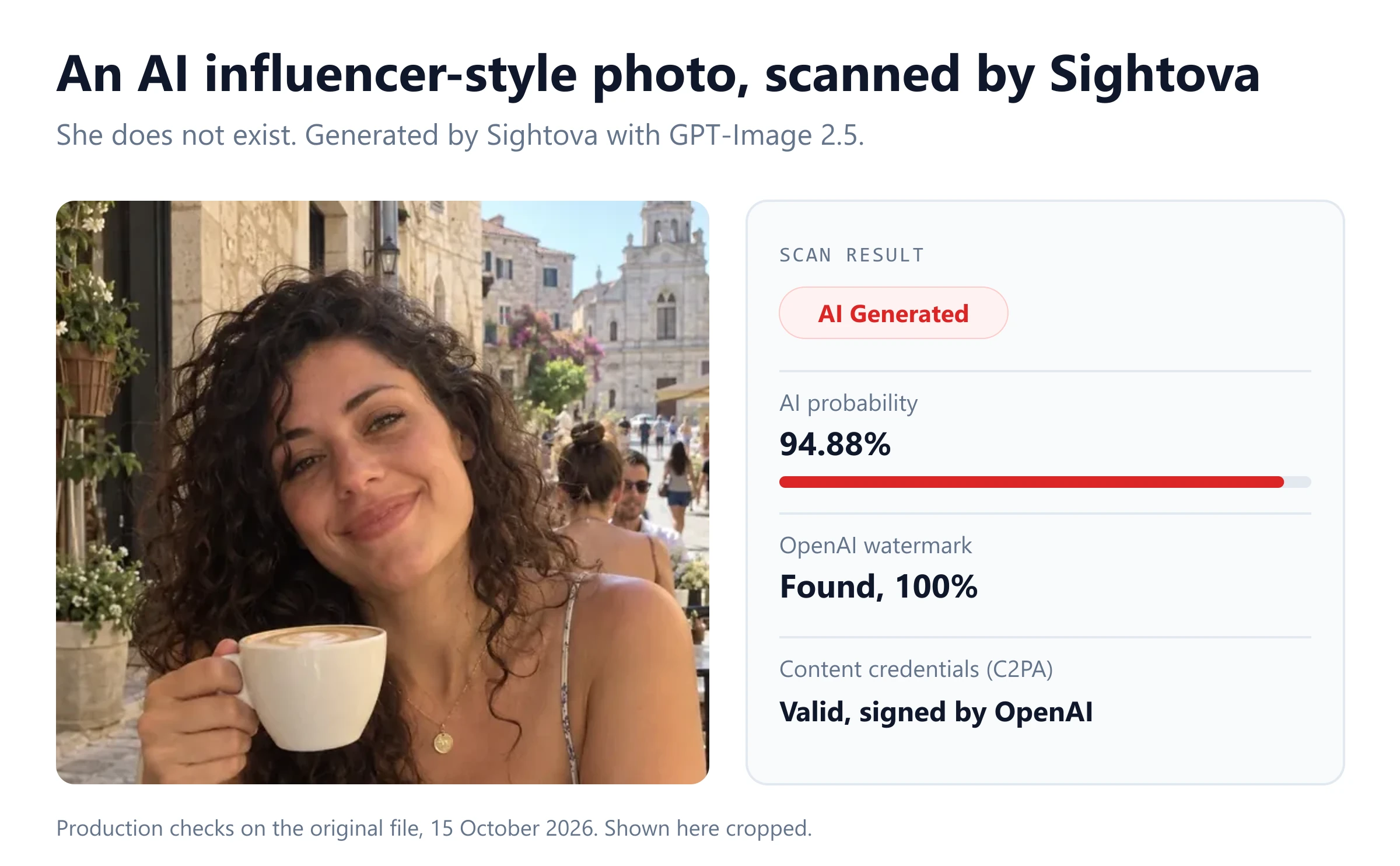
Sightova's AI image detection is live. Every scan runs three independent checks and returns the result in seconds:
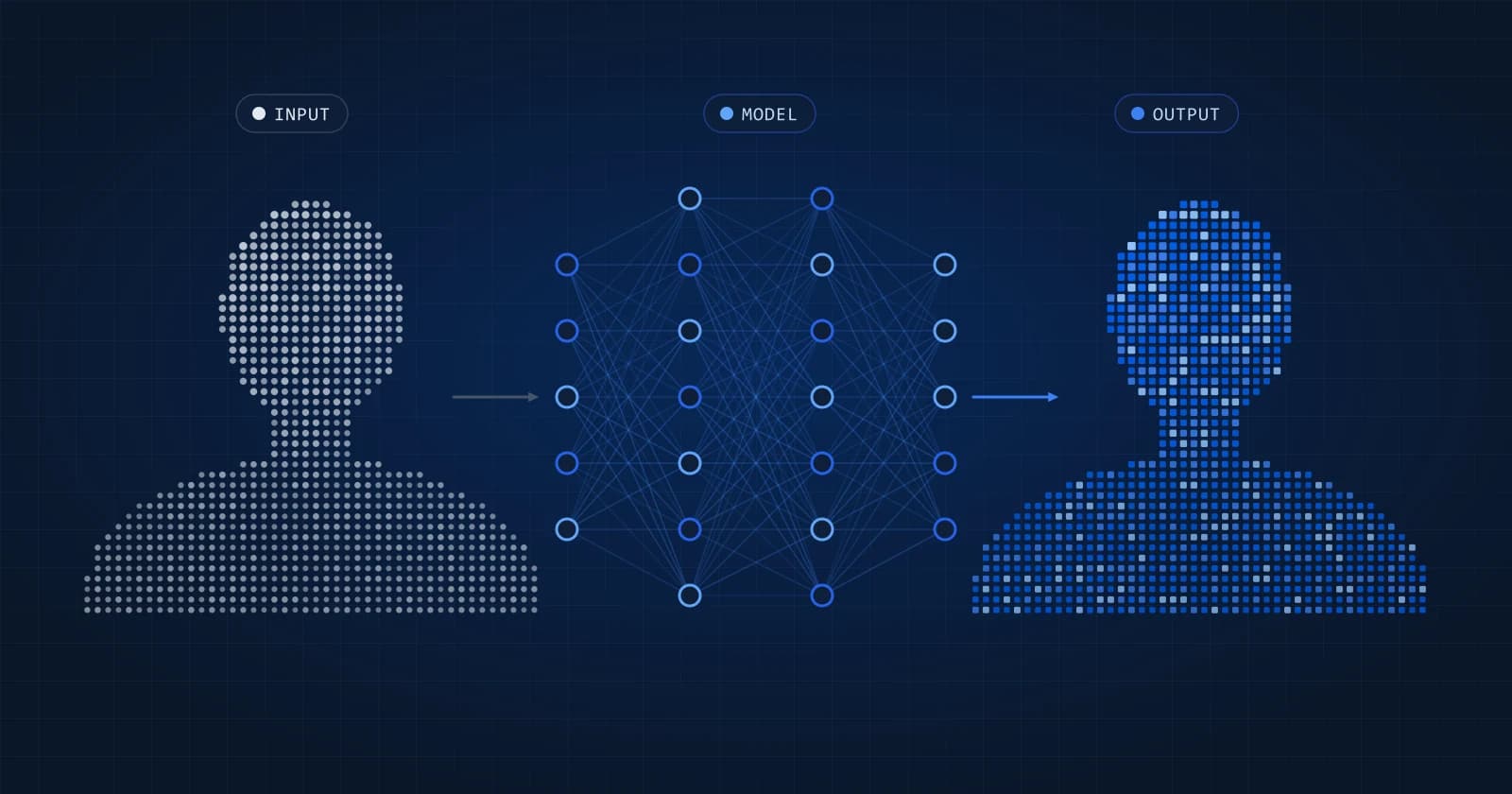
- Pixel-level detection. A detection model reads the image for traces of AI generation and editing, and returns an AI probability and a verdict. It keeps working when social platforms and messaging apps have stripped the metadata.
- Invisible watermark detection. Finds the watermarks Google (SynthID) and OpenAI hide in images from their tools, and names the source when one is found.
- Content credentials and metadata. Reads C2PA manifests and EXIF data, which can state the tool that made the image.
On Starter plans and above, a heatmap shows which parts of the image the model reads as generated or edited.
The woman in the example above was generated by Sightova with OpenAI's GPT-Image 2.5 for our dating fraud page; she does not exist. On the original file, all three checks flagged her as AI-generated.
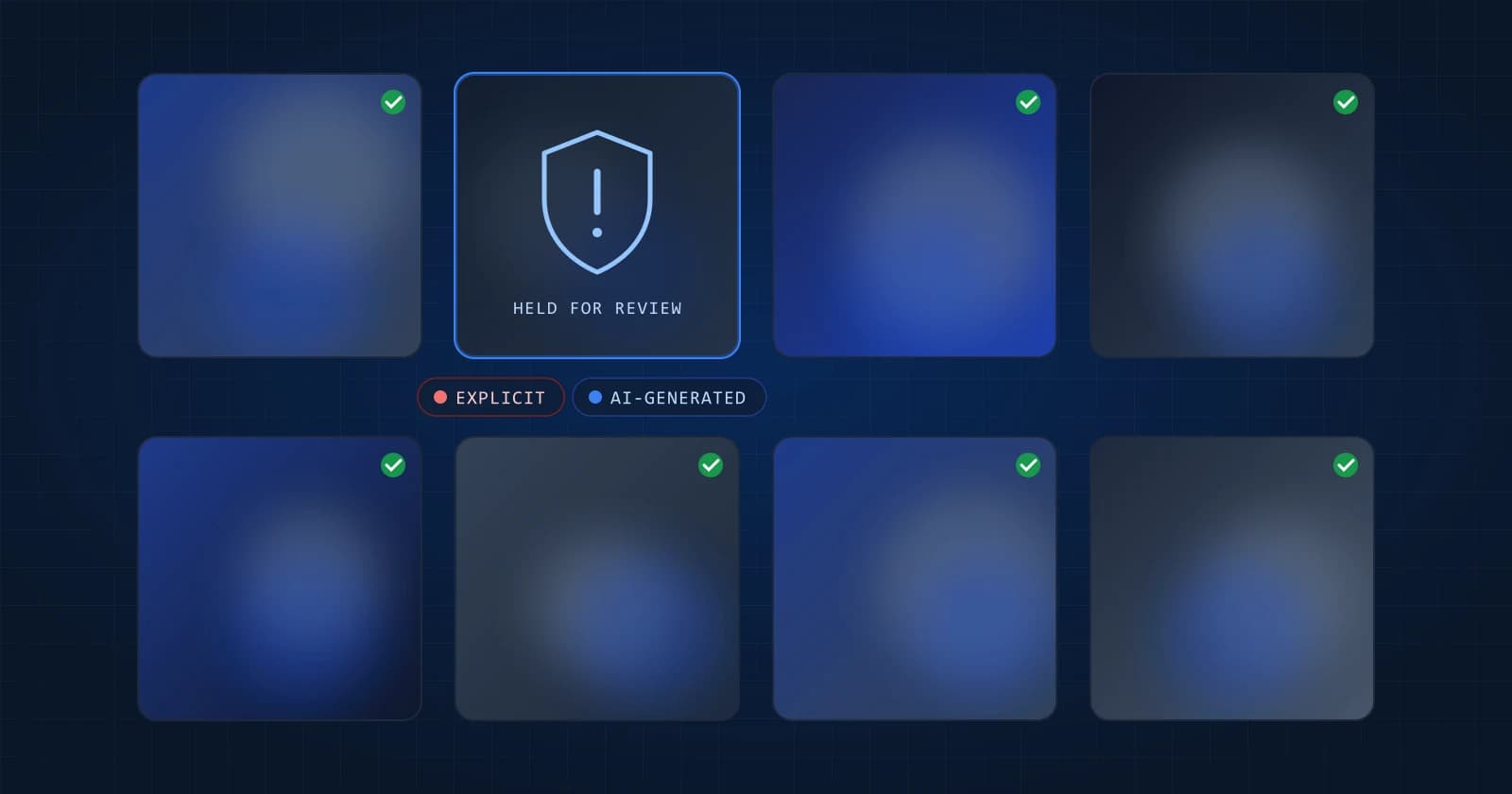
- Platforms scan profile photos and posts at upload through the API and route AI-generated accounts to review.
- Brands and agencies check a creator's photos before signing a deal.
- Anyone can check a profile photo in the dashboard before sending money or personal details.
Video: frame-by-frame detection
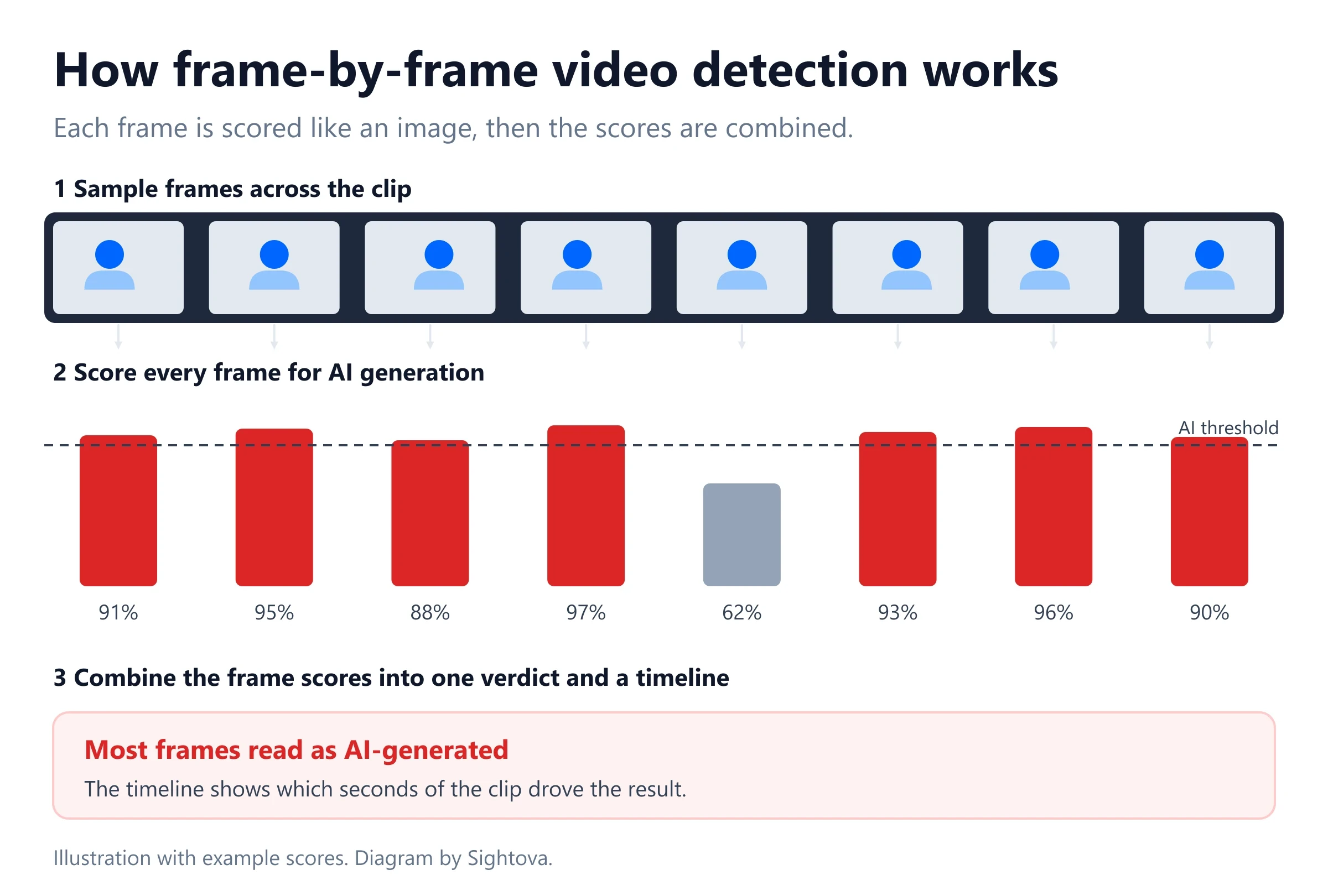
Most of these accounts grow on short video, where a fully generated clip or a face swap on stolen footage does most of the work. Video detection works frame by frame:
- Sample frames across the clip.
- Score each frame for AI generation, the same way a single image is scored.
- Combine the scores into one verdict, with a timeline that shows which seconds of the clip drove the result.
A frame-by-frame view matters for face swaps on real footage, where the generated face may stand out in some frames more than others. Sightova's AI Video Detection checks AI-generated video this way, with a verdict and a frame timeline for every clip, on the Starter plan and above.
Detect AI-generated images with Sightova
Scan in the dashboard or build it into your upload flow with the API.
Frequently asked questions
What is an AI influencer?
An AI influencer is a social media account built around a person who does not exist. The images, videos and often the captions are generated by AI. Some are openly run by brands or agencies; others present themselves as real people.
Who is the most followed AI influencer?
Among disclosed virtual influencers, Lu do Magalu, the virtual presenter of the Brazilian retailer Magalu, had about 8 million Instagram followers and 7.4 million TikTok followers in August 2025, according to VnExpress.
Are AI influencers legal?
Running a virtual influencer is legal. Hiding paid promotion is not: the FTC's Endorsement Guides cover virtual influencers, and from 2 August 2026 the EU AI Act requires deepfake content to be disclosed. Using real women's photos or videos without permission, or using a persona to defraud people, is a separate matter that platform rules and the law already cover.
How can you tell if an Instagram model is AI?
Look for an unnaturally consistent face across very different settings, a lack of live or candid video, flickering at the jaw and hairline in videos, a hidden AI disclosure in the bio, and links that push followers to paid content. Then scan the images with an AI detector.
Can Sightova detect AI influencer photos and videos?
Sightova detects AI-generated images using pixel-level detection, Google SynthID and OpenAI watermark detection, and C2PA content credentials. AI-generated video is checked frame by frame with AI Video Detection, on the Starter plan and above.