Contents
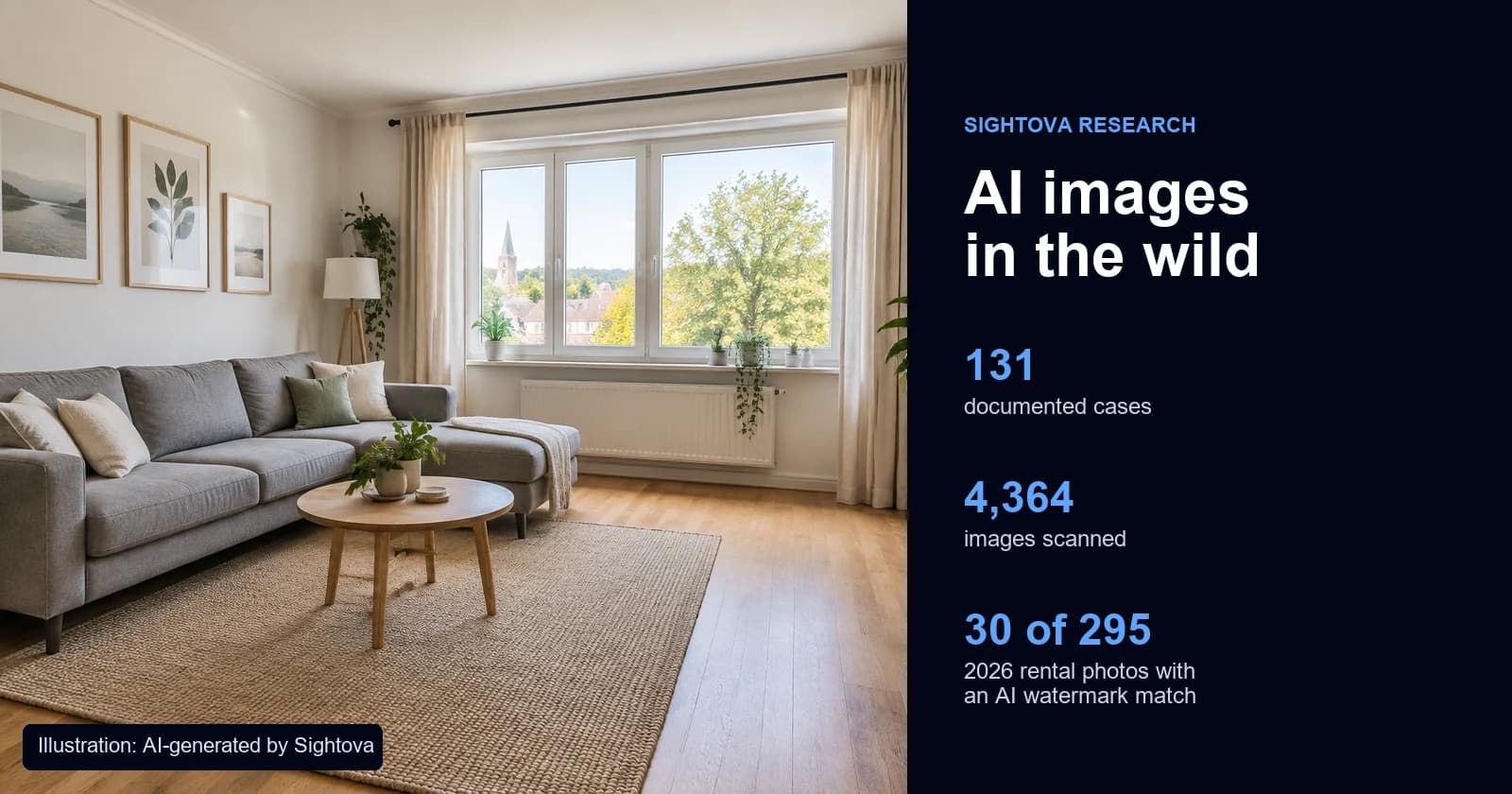
AI-generated pictures now turn up in newspapers, police press releases, book covers, stock libraries and rental ads, usually without a label. We gathered 131 cases that journalists, fact-checkers and researchers have documented since late 2022, looked at how fact-checkers now catch these images, and followed what happens to AI labels as images travel. We also ran our own detectors over 4,364 public images. Sourced findings come first; our own scan, which has real limits, comes second.
Key findings
- The commonest way in was ordinary work: staff using consumer AI tools in-house, often to "enhance" a real photo.
- The public usually noticed first, in about half the cases. Hidden file metadata helped catch none of them.
- Fact-checkers have turned to invisible watermarks. SynthID was mentioned in none of Full Fact's AI-image fact checks in 2024 and in 69% of them in 2026 so far.
- AI labels fall off as images travel. In our own test, simply re-saving an AI image deleted its label, and a screenshot erased its watermark.
- Rental photos started carrying AI watermarks in 2026. On a large Norwegian rental site, 30 of 295 listing photos uploaded this year matched an AI watermark, against none of 483 older photos. Most of those listings said nothing about AI.
- Our detector flagged clearly more recent images than older ones in free stock libraries and in rental and shop listings. News sites showed a smaller, less robust difference; viral posts on Mastodon showed none.
How AI images get in: 131 documented cases
The cases run from December 2022 to September 2026. 24 are Nordic, 19 of them Norwegian. We rated 78 as high confidence, 46 as medium and 7 as low or alleged, and we don't name the last group.
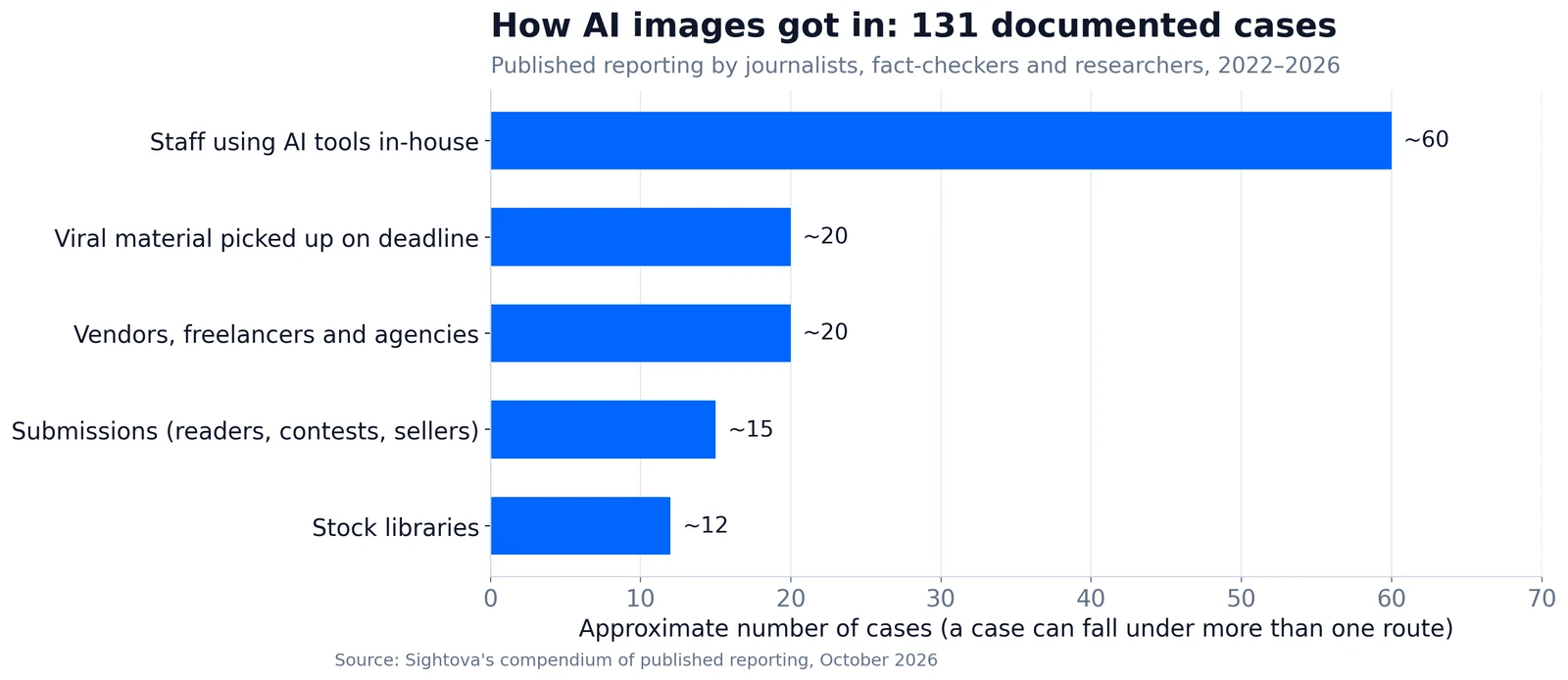
Staff using AI tools in-house. A growing type is the AI edit of a real photo, which still looks genuine but shows altered details. A Maine police department posted a drug-seizure photo that an officer had run through an AI tool; the packaging text turned to gibberish, and after first denying AI use, the department apologised (WABI). Smaalenenes Avis used an AI tool only to correct the white balance of a photo of Norway's transport minister; it also changed details in the picture, and the editor apologised (Journalisten).
Viral material picked up on deadline. Dagbladet, Se og Hør and VG ran stills from an AI-generated TikTok version of the "Coldplay kiss-cam" clip, then corrected (Medier24). In September 2025 several UK outlets ran "Afghanistan earthquake" images that Full Fact found were likely made with AI; all of them removed them (Full Fact).
Vendors, freelancers and agencies. NTB, Norway's national news agency, found "AI-affected" images in its photo portal and removed them the next day (Medier24). DW reported that doctored images from Iran, some manipulated with AI, reached European newsrooms through photo agencies (DW).
Stock libraries. Bloomsbury put an image that Adobe Stock itself marked as AI-generated on a book cover (The Bookseller). Adobe Stock sold labelled AI images of the Israel–Gaza war, which some small outlets ran unlabelled (Crikey). Labelled at the source, unlabelled downstream.
How they were caught. The public raised the alarm first in about half the cases, usually over extra fingers or garbled lettering, and comparing with the original photo was the most decisive check. Detection tools featured in about a dozen cases, mostly as corroboration. Invisible metadata such as C2PA content credentials played no role in any case.
What happened next. About 95 cases had no AI label at all and 19 only a small one. The usual response was removal (about 65 cases) or an apology (about 32); in about 34, nothing changed.
Fact-checkers turned to watermarks
Some AI tools hide an invisible watermark in the pixels. Google's SynthID is the best known; OpenAI also marks images from its tools. At two fact-checkers whose sites allow automated collection, we counted the AI-image fact checks that mention SynthID.
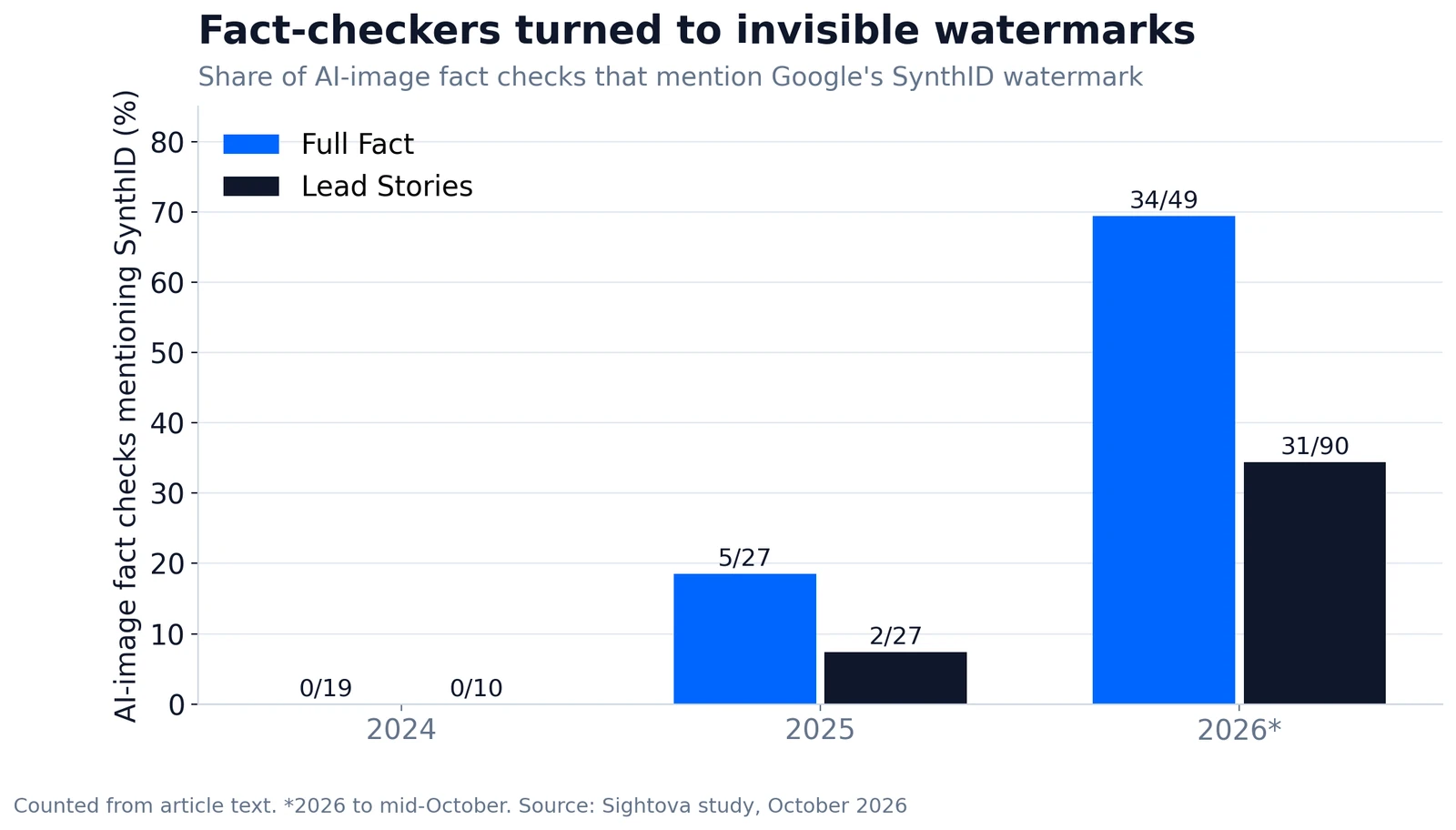
These are mentions in the text, and the 2024 numbers are small. A watermark shows an image was made or edited with that company's tools, not that it is "fake", and it only helps if the copy you check still carries it.
Labels fall off as images travel
An image can say it is AI in three places: in the file (C2PA content credentials or an IPTC tag), in the pixels (a watermark), or on the page. To show what survives, we took an AI-generated listing photo we had made ourselves with OpenAI's image model and copied it the way pictures travel online.
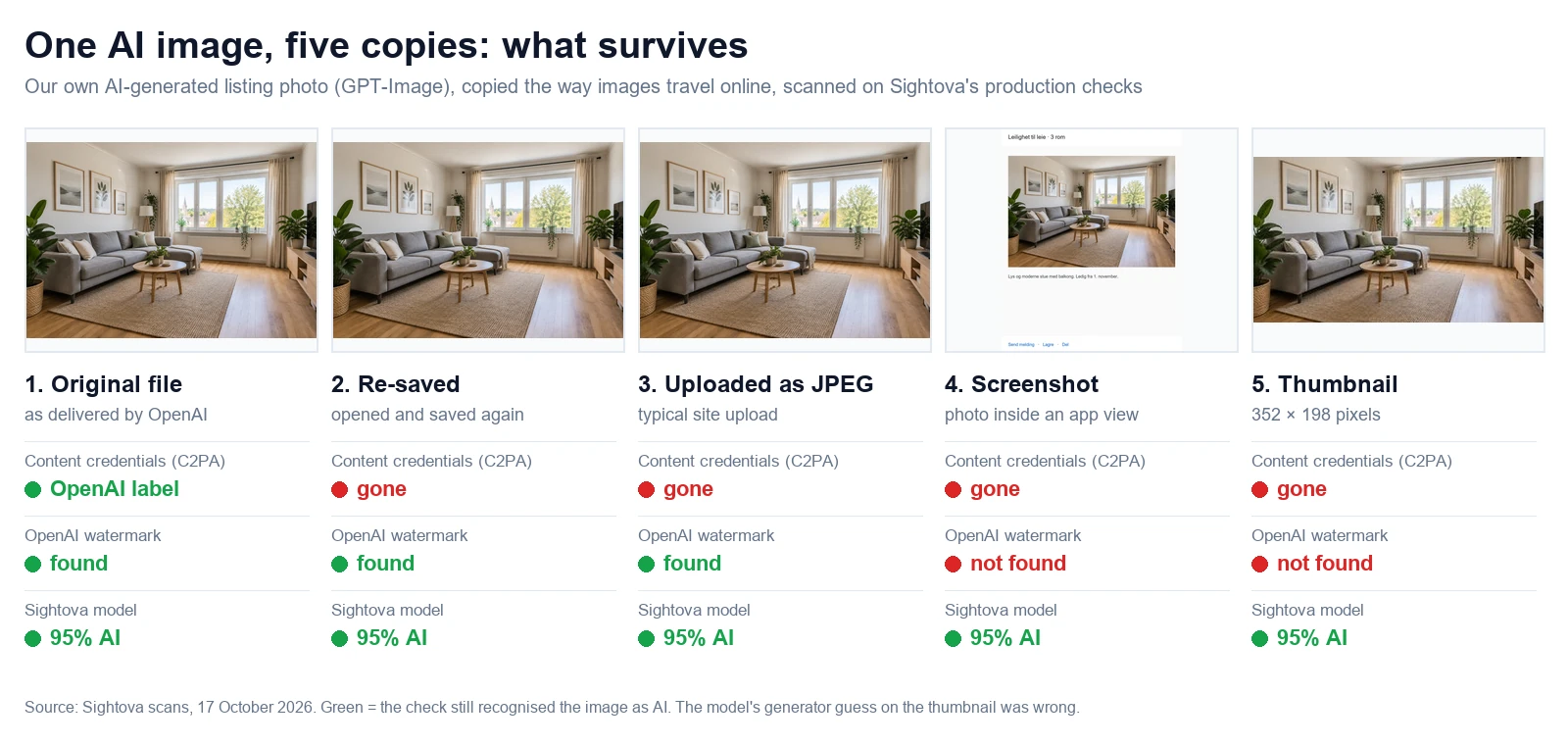
Two things stand out. The label in the file disappeared the first time the image was opened and saved again, with no intent to hide anything. And the watermark, which survived an ordinary JPEG upload, was gone once the picture appeared inside a screenshot or as a small thumbnail.
The pattern held across everything we collected. None of 1,477 images from fact checks, Bluesky and Mastodon declared AI in the file. The image servers behind most of our news sample strip all metadata. None of 1,366 images from a rental site and 66 web shops carried content credentials, and neither did any of the 164 images we collected from the documented cases, even originals made with ChatGPT or Midjourney.
Page labels get lost too. After a February 2026 strike on a school in Minab, Iran, an AI illustration of mourners was first posted with a note that it was AI. It spread without the note, and Full Fact and Faktisk debunked claims that it was a real photo (Full Fact, Faktisk).
Stock libraries: the platforms' own labels
Unsplash and Pexels don't accept AI-generated uploads under their terms; Pixabay accepts them if the uploader ticks an AI box. Only 3 of the 13 free libraries we checked could be collected within their terms and without an API key.
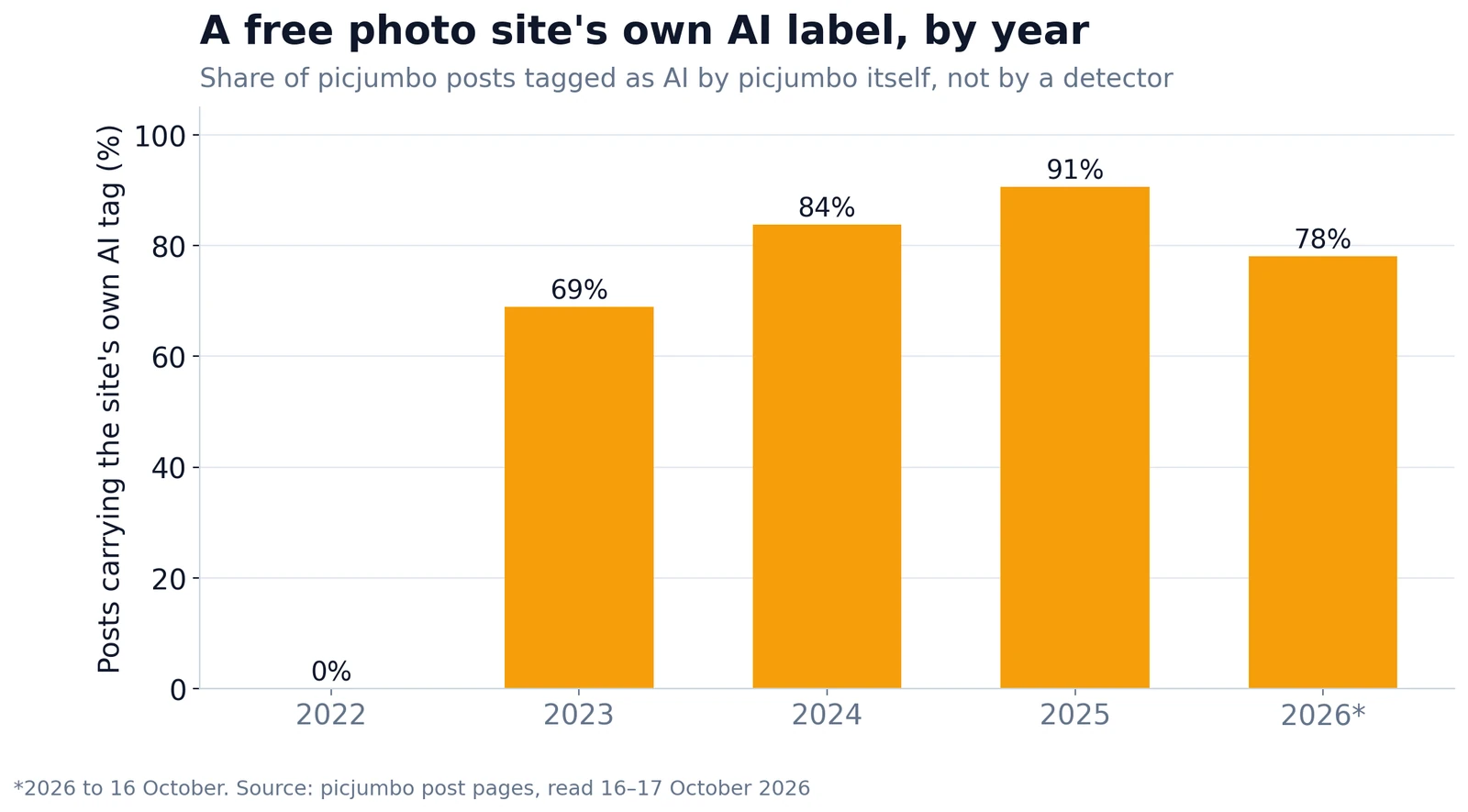
picjumbo shows a label working at the source and vanishing downstream. By its own AI tag, 84% of its 2024–2026 uploads are AI images, up from none in 2022. The label is a short line under the title, and the copy the page displays has all metadata removed, so a file saved from the page contains nothing that says AI.
Wikimedia Commons files AI images in dedicated categories. In a random sample of 700 Commons photos uploaded since 2024 and not categorised as AI, 4 carried file records of generative-AI editing. None showed an AI label on Commons.
Credit lines in the news
Of 814 recent images in our news sample, 230 (28%) credited a stock agency such as Getty/iStock, Shutterstock, Unsplash, Pexels or Colourbox. None of those credits mentioned AI. We have no evidence that these images are AI-generated, and this finding does not suggest it. It shows a gap: some agencies now sell labelled AI images, and a credit such as "Illustration: Shutterstock" can't tell a reader whether the agency labelled that image as AI.
What our scan found
Our samples hold 3,123 images after we left out images whose page already disclosed AI, the documented cases and duplicate copies: 2,033 recent images and 1,090 images the same sources published before 2022.
Declared in the file
Nine images declared AI in the file without any AI label on the page: eight from one free stock library, whose files carry the library's own AI tag while the page calls them photos, and one Wikimedia Commons photo whose content credential records a generative-AI composite made in Photoshop. None of the pre-2022 images did.
Watermarks
46 images triggered our check for Google's or OpenAI's watermark. On review, 9 of them, all graphics or screenshots and including all 3 hits on pre-2022 images, look like false alarms: flat graphics are a known weakness of watermark checks. The other 37, 34 photos and 3 illustrations, gave no reason to doubt the match, but none has yet been confirmed with the vendors' own checking tools, so we name none of them.
Rental listings
The clearest pattern came from a large Norwegian rental site.
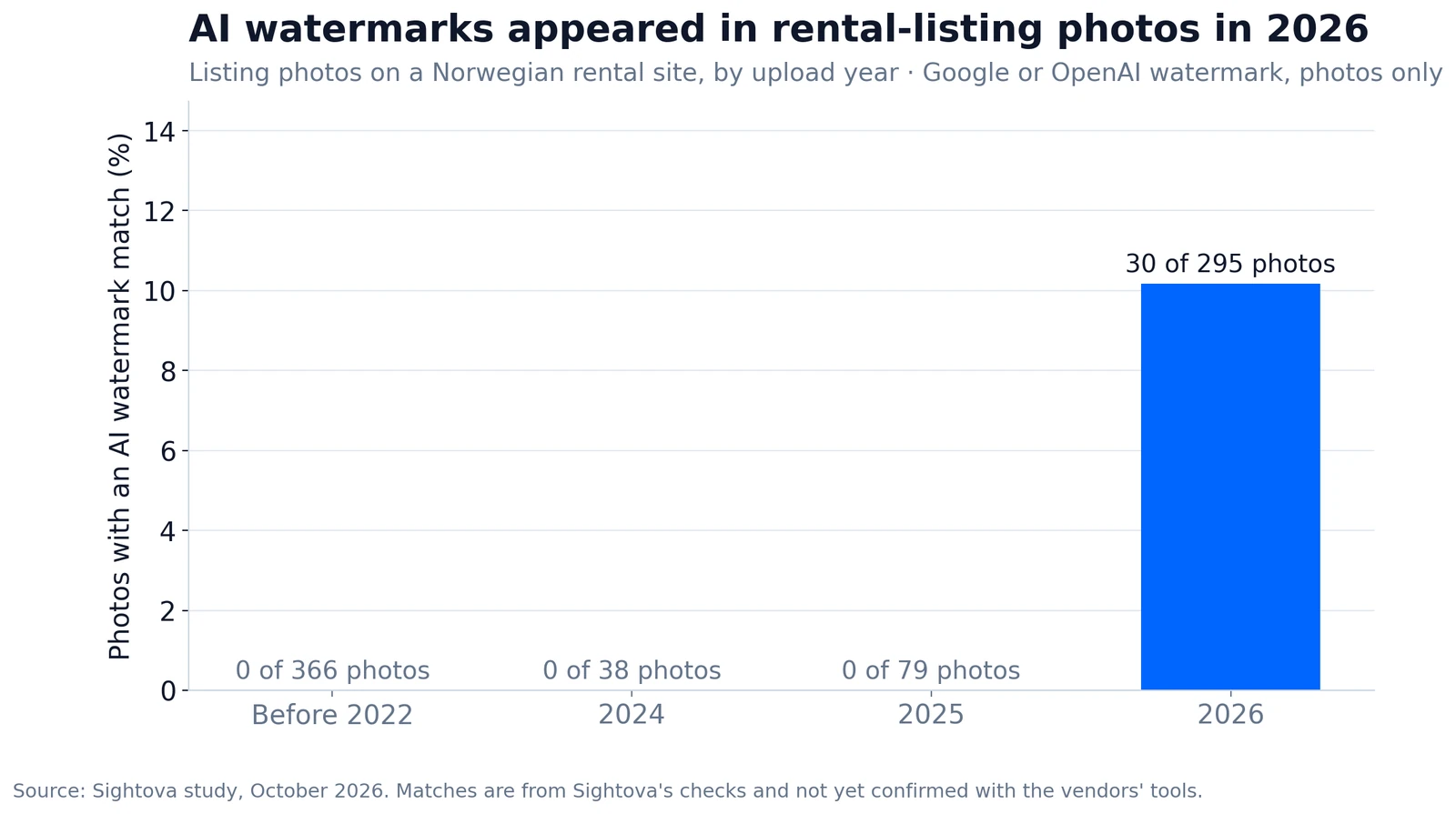
Among listing photos uploaded in 2026, 30 of 295 carried a whole-image watermark match, spread over 14 of the 100 listings with 2026 photos. None of the 483 photos uploaded earlier did. Three of the 14 listings said the photos were AI-generated or "AI-furnished"; eleven said nothing. Most look like real rooms with virtually added furniture, and some look like ordinary photos run through an AI "enhance" step. This is an aggregate finding: we name no landlords, and the matches are not yet vendor-confirmed.
Our detector model, against a pre-2022 baseline
Flags on images published before 2022 are false alarms, so the comparison with the same sources' older images is what matters.
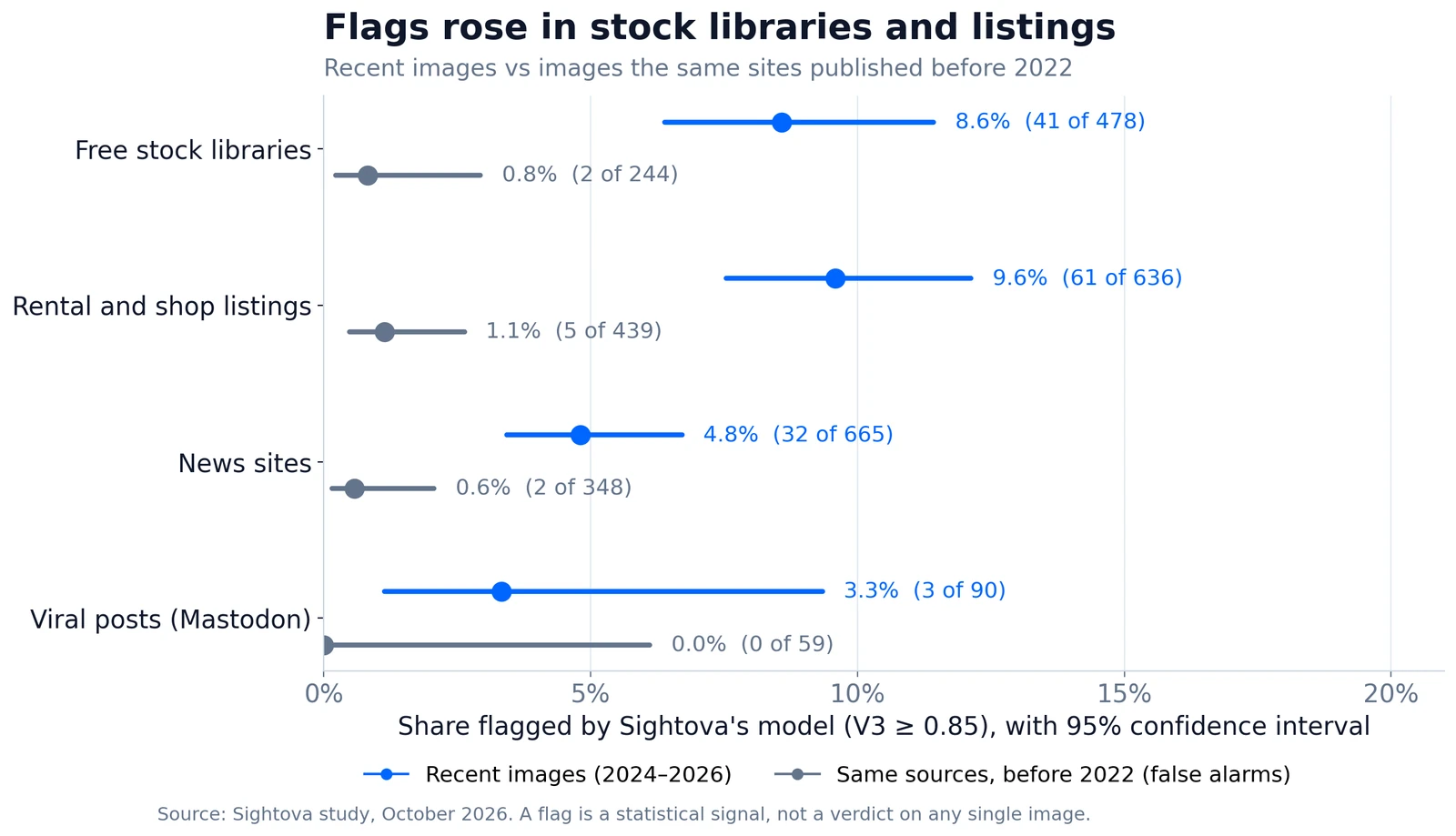
| Source type | Recent, flagged | Pre-2022, flagged | Difference, points (95% CI) |
|---|---|---|---|
| Stock libraries | 41 of 478, 8.6% | 2 of 244, 0.8% | +7.8 (+4.7 to +10.7) |
| Rental and shop listings | 61 of 636, 9.6% | 5 of 439, 1.1% | +8.5 (+5.9 to +11.1) |
| News sites | 32 of 665, 4.8% | 2 of 348, 0.6% | +4.2 (+2.2 to +6.2) |
| Unlabelled viral posts, Mastodon | 3 of 90, 3.3% | 0 of 59, 0.0% | +3.3 (−3.2 to +9.3) |
We treat the differences as conservative estimates of the share of AI images in these samples. A detector flag is a statistical signal, not a finding about any single image.
How firm are these numbers? If we count only images the model scores at 0.95 or above, the gap stays clear for stock libraries (2.5 points, 0.6–4.3) and listings (2.7 points, 1.4–4.2), but for news it is no longer distinguishable from zero. Most news flags sit just above our cut-off, and when we looked at them, several were real wire photos, so treat the news figure as weak. In the stock sample, most of the gap comes from one small library where every one of the 27 recent "photos" we sampled looks AI-generated on inspection, while none of its 45 older ones does.
For unlabelled viral posts on Mastodon we found no detectable difference from the pre-2022 baseline. Our Bluesky sample has no pre-2022 baseline, so we report no rate for it.
These figures describe the images we sampled. They are not an estimate for news sites, stock libraries, marketplaces or social media as a whole.
What detectors can't see
Most people see copies: screenshots, thumbnails, fact-checkers' stamped cards. Our clean test image survived all of them on the model, but the real copies in our collection were harder. On fact-check graphics where the AI picture sat small inside a stamped card, our model usually missed it, and fact-checkers reported watermarks on originals whose re-published copies carried none we could detect.
So a watermark check means most on the earliest copy you can find. A watermark that is found shows the image, or its source, was made or edited with that company's tools. A missing one, especially on a screenshot or card, proves nothing; nor does a low detector score.
Watermark checks can also misfire. Our check for Google's watermark fired on several screenshots of text and charts, which is why we treat a hit as confirmed only when the vendor's own tool agrees.
The lesson is about provenance: keep labels attached, check the earliest copy, and treat a missing label or watermark as "unknown", never as "real".
How we did this
On 16–17 October 2026 we collected 5,787 publicly available images from 173 sources: fact-checkers and two social networks, three free stock libraries, 14 news sites, three sites NewsGuard identified as AI-generated news sites, a Norwegian rental site, 66 web shops, and published copies of images from the documented cases. We used public pages, feeds, sitemaps, APIs and archives, followed each site's robots.txt and terms of use, and did not log in, bypass paywalls or collect from sites that forbid automated access. We skipped profile pictures and other images of private individuals.
Three kinds of evidence. Declared: the file says it is AI-generated, through content credentials or metadata written by AI tools. Watermarks: invisible marks that Google and OpenAI add to images made or edited with their tools; we name a hit only after the vendor's own tool confirms it. Our detector model, Sightova V3, which gives each image a probability of being AI-generated or AI-edited; we count an image as flagged at 0.85 or above.
Accounting for mistakes. Every detector sometimes flags genuine photos, at a rate that depends on the source. So we also scanned 1,090 images the same sources published before 2022, before today's generators were widely available; flags there are false alarms. Ranges are 95% confidence intervals (Wilson score; Newcombe's method for differences). We fixed the analysis plan in writing before analysing the news, stock and listing results, after the first scans had begun, and logged every later change.
What we don't claim. Our model can describe a group of images, not any single one, so we never name a publisher or show an image on the strength of a detector score. We name a source only when the file declares itself AI-generated or carries an independently confirmed watermark, and only after giving the publisher at least five working days to respond. Our measured error rates are on our testing methodology page.
Limitations
- Our samples skip the biggest players. Most large publishers, stock libraries and marketplaces forbid automated collection or require an API key or permission, which ruled out every major Norwegian news outlet we checked.
- The case compendium covers only cases that were caught and reported, mostly in English and Norwegian.
- The fact-checker figures are keyword counts at two publishers.
- Newer cameras and editing tools may make recent genuine photos harder to judge than older ones, which could inflate our estimates slightly; our detector also misses some AI images, which pushes the other way.
Corrections and contact
If you think we got something wrong, tell us. We note the date and nature of every change at the top of this page and never remove a finding silently. Organisations named here can ask us to add their response.